

Britain swelters in a heatwave. A Labour prime minister resigns halfway through a parliamentary term and is replaced by an affable party veteran. In the Treasury, Healey pores over the gloomy public finances. Over the summer, the new prime minister plots a major speech rejecting a decades-long consensus in British politics.
But it’s not 2026, it’s 1976.
Back then, Jim Callaghan had just taken over from Harold Wilson, and was preparing a major set-piece speech on education in which he challenged the bipartisan consensus that had underpinned education since 1944. It became known as the “Secret Garden” speech, and you could argue that it helped to establish a new educational consensus that has existed ever since.
This year is its fiftieth anniversary, and I’ve been planning to write about it all year. But I’ve finally got around to it now because the change in prime minister in the UK means it is relevant in a slightly different way to the original article I had planned. Not only are there lots of parallels between now and 1976, but the UK’s new prime minister, Andy Burnham, has taken power with a promise to devolve power. The Secret Garden speech tentatively proposed the opposite: that central government should have more power over what schools did.
In 1944, the Butler Education Act established a highly decentralised system in which central government had little direct control over what schools taught. Central state intervention in the curriculum was quite often seen as the kind of thing that might be suitable for continental dictatorships, but not for free-born Englishmen. In this era, both Labour and Conservative politicians can be found reacting against the idea of state oversight of the curriculum.
But as the decades wore on, cracks appeared in that consensus, and Callaghan’s speech brought them decisively into the open. It is known as the “Secret Garden” speech because Callaghan compared the world of education to a secret garden that elected politicians, parents and ordinary taxpayers were not allowed to have an opinion on, even when things were obviously going wrong.
In a tentative and roundabout way, he suggested that a national curriculum might not be a bad thing: “It is not my intention to become enmeshed in such problems as whether there should be a basic curriculum with universal standards - although I am inclined to think there should be.” Even that circumlocutory phrasing was inflammatory, and was enough to bring out the “continental tyranny” counter argument: the general secretary of the head teachers’ union compared the proposal to Nazi interference in the 1930s German curriculum.
Whilst Callaghan’s speech was just a speech, and wasn’t followed up by any legislation on curriculum, it was enormously influential and was frequently cited 12 years later when the Conservative government passed the landmark 1988 Education Reform Act, which did introduce a national curriculum and substantially reduce the influence of local authorities. We have had several changes of government since then, and more prime ministers than I can count, but none of them have really sought to rip up this settlement. Most have tried to advance it.
Why did the grass get trodden on?
Why did the consensus shift so dramatically? I can think of three reasons, the last of which is especially relevant for our own times.
First, the global economic situation changed. In 1944, Britain was about to win a world war and continental Europe was devastated, which made it more likely for British exceptionalism in any area to be perceived positively. By 1976, West European economic growth had outstripped Britain’s, and British educational exceptionalism started to look like complacency and self-indulgence. Callaghan’s speech frequently emphasises the importance of high standards to enable students to compete in a modern, global economy.
Second, there were some obvious examples where local authority management was not working. Probably the most famous was the William Tyndale affair of 1974-76, where the progressive over-reach of an Islington junior school created national headlines. Callaghan doesn’t specifically mention it, but it’s probably what he is thinking of when he says “the new informal methods of teaching which seem to produce excellent results when they are in well-qualified hands but are much more dubious when they are not.”
Third, and most relevantly for our current situation, the fiscal situation changed. Between 1944 and 1976, central government grants came to make up a larger proportion of local government spending – and a larger proportion of national spending too. This created a lot of tensions between local and central government. Central government got fed up with taking the political hit for tax rises that then went to pay for local government priorities. Local governments got fed up with being loaded up with complicated and non-negotiable legal responsibilities and being underfunded for them. Lines of accountability were unclear. If someone was unhappy with the services in their area, who was to blame? The local authority that provided them, or the central government for not funding them properly? Each side could – and did - blame the other.
Ultimately, in the area of education and many others, central government often got its own way because he who pays the piper calls the tune. It was always going to be unsustainable for education to receive so much funding from central government, but for central government to have so little say over it. When it came to the curriculum, this maybe didn’t matter too much, as I think you can make a good argument from first principles that central government involvement is necessary. But in a lot of other areas – both in education and elsewhere – it probably isn’t ideal to have central government in charge of so much local detail.
And this is a major issue in 2026: Andy Burnham has arrived promising to devolve more powers to local regions. But the lesson from the past is that if you devolve power and responsibility without commensurate tax-raising powers, you get problems. You risk getting irresponsible local authorities, and a meddlesome central government.
OK, you might say, why not just devolve the tax-raising powers too? This would clarify the lines of accountability, and make local authorities responsible for both the services and the finances. There are plenty of challenges and risks to this, but one big one is that if you did that, you would get big variations between different regions – postcode lotteries, as they are known. Some areas are wealthier than others and would have more money to spend. Some regions would also make different choices about how that money should be spent. You could end up with individuals living on adjacent streets who would have access to very different types of service. And the problem is that these kinds of discrepancies are anathema to the average citizen. We hate postcode lotteries. Most serious proponents of devolution recognise this as the biggest obstacle to devolution, but even then, I am not sure they realise quite what an obstacle it is.
Is centralisation a fundamental British value?
For a very good and topical illustration of this, take a look at a recent lesson published by Oak National Academy. In a sign of just how much has changed since Callaghan’s time, Oak are a government-backed provider of educational materials. Earlier this month, they published a set of resources about the rule of law, which is defined as a fundamental British value. Two examples of the rule of law provided in the resources are as follows.
(1) Craig is a famous celebrity who is caught speeding. The police officer lets him off because he is famous.
(2) Jun has a place at a new school that is a two-hour walk away. The local council will not provide him with a free bus or taxi to school.
When I first read these, I thought (2) must be some kind of mistake. My understanding of the rule of law is exemplified by (1). (2) seems to me to be something very different.
My recall of this from my very distant AS level Politics course is that breaking the law and breaking the rule of law are different things. A public body can act unlawfully without necessarily undermining the rule of law, just as an individual can break the law without threatening the constitutional order. The rule-of-law question is whether Jun can challenge the council’s decision before an independent court and secure a remedy, not whether a council always gets every decision right.
But there are times in life when you have to bow to superior knowledge, and this is one of them. These resources were developed by Oak in partnership with the Association for Citizenship Teaching and the Attorney General’s Office. The Attorney General is the government’s chief legal adviser. So clearly my AS level understanding is wrong, or something has changed in the last 25 years.
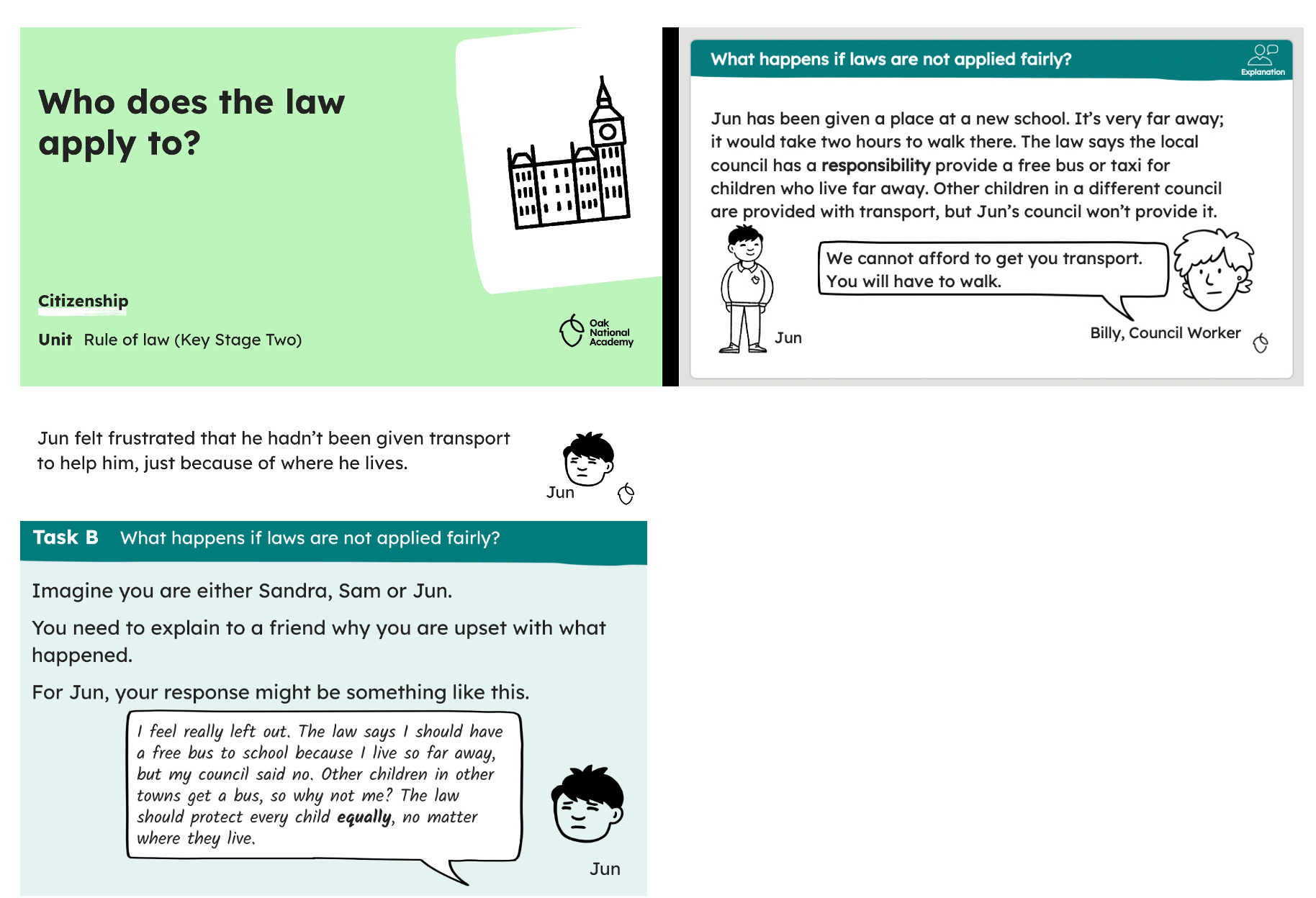
And I also have to concede that whilst I am wary about this example, I suspect that a lot of parents and children will quite like it – because, as I say, people hate postcode lotteries. In fact, the law that this hypothetical council is breaking in this example is one of the top-down statutory duties imposed by central government on local government. If you had serious regional devolution, it would mean repealing a lot of these statutory duties and giving local authorities more discretion around things like whether or how to allocate free school transport.
If we follow through the logic of these resources, we end up in a place that is very uncomfortable for proponents of devolution. If the rule of law is a fundamental British value, and if local authority discrepancies in school transport are a violation of the rule of law, then we have reached the point that centralisation is a fundamental British value – and that devolution is therefore fundamentally un-British.
Keep the garden open
And, to return to the original point about changing consensus, it is fascinating to see how the consensus on state involvement in the curriculum has shifted. Fifty years ago, the mere suggestion of a national curriculum was criticised as being the first step on a road to Nazi Germany, and local authority control was seen as vital. Today, we have a state curriculum agency producing resources in alliance with the Attorney General’s Office, and those resources teach students that discrepancies between local authorities are violations of fundamental British values.
I basically agree with most of what Callaghan said in the Secret Garden speech. I think he was right to say that education is an area of legitimate political interest, and I think a basic national curriculum is a good thing. It’s obviously not true to claim that it’s a short step from a national curriculum to Nazi Germany.
You will often hear people talk about how we should “take the politics out of education”. In one sense, this is neither possible nor desirable. Everyone in a nation has a legitimate interest in how its children are educated, and politics is the forum in which we manage the conflicts between different interests. In a nation where education is compulsory and where taxpayer money is used to fund most schools, this is even more the case.
However, there is another narrower sense in which I think we can and should take the politics out of education, which is that the education students receive should be neutral in terms of party politics, and in terms of controversial contemporary political issues. Devolution and school transport funding are live and controversial political issues, and I am not sure the Oak resources do present a rounded view of them. There are other resources in the rule of law collection which similarly take on recent political controversies in ways that I suspect not everyone would be totally happy with.
Still, to end on a positive note, I think that education in England is in a much better state today than it was fifty years ago, and part of the reason for that is that the secret garden has been opened up. We just have to make sure it stays open, and no new secret gardens are allowed to develop!
I found your article intriguing and thought provoking. Thank you. Too many aspects on which to comment. Interesting that Andy Burnham wants to overhaul education. Loads in the press today about wanting to address opportunities for those youngsters who don't or can't see a higher education degree as an option for them. As someone who's been banging on about this for the last two decades it feels too little, too late. No mention in the press that over 80% of secondary schools in England are academies or free schools. They are in law independent schools, albeit in receipt of funding through central government. They aren't bound by the national curriculum. They aren't bound by many obligations that apply to local authority controlled schools. It'll be interesting to see what comments Mr. B makes about that.
In respect of James Callaghan's speech I can understand his feelings. In 1976 I'd completed my degree and a teaching qualification although I was unconvinced that teaching was for me. I'd done my teaching qualification based on teaching English and drama at secondary level. Three teaching practices in Manchester disuaded me. I enjoyed the kids and had no problems with discipline. It was the system and the attitudes of the service teachers that put me off. After spending three years trying a variety of other jobs I ended up being offered a post in a primary school and that was the road I followed
1976 marked the ending of the compulsory 11 plus in England. I'd failed the 11 plus though ended up in a comprehensive school so had the opportunity to progress to A levels. The pass rate was around 20%. Those deemed suitable for an academic education. Though only about 10 to 12% went on to H.E. And as that percentage would have included those in private education who probably wouldn't have taken the 11 plus and those like me who failed it, the 20% deemed academic patently wasn't a secure assessment.
In the days of grammar and secondary moderns most teachers in grammar schools were graduates and in secondary moderns they were mostly T.Certs. This was of course before teaching became an all degree profession. In my comprehensive we had a mixture. As I understood it only subject graduates got to teach A level. Would Mr. Callaghan have considered the use of drama in history lessons a bit liberal I wonder or Elephant jokes to teach clause analysis in English ditto. They got me top grades in O level. My A level teachers may well have had good degrees but boy were the lessons dull.
I never had a problem with the national curriculum or the various English and maths strategies that followed. I favoured the approach advocated by Professor John McBeath. Act first and ask for permission after. I think the NC was way too content heavy but there was no expectation that you had to teach it by the letter and certainly no hard or fast rules on how to teach anything. As a head I was much more interested in teachers being enthusiastic, well informed and well prepared.
If Andy Burnham plans to shake up secondary education I wish him well. Will he be radical enough to dismantle multi academy trusts and return schools to local authority control and accountability I wonder. And will he also take the next logical step and ask what's the real purpose now of higher education.
“It was always going to be unsustainable for education to receive so much funding from central government, but for central government to have so little say over it.”
Replace central with federal, and this is the situation in Australia.
We have a national curriculum which is ‘adapted and adopted’ eight different ways for eight different jurisdictions. Yet the funding demands on ‘the government’ (when we have nine) always means the federal level.