

Between 2010 and 2024, England carried out a significant programme of education reform. It now has a more knowledge-rich national curriculum, more terminal exams and more policies recommending or even mandating approaches like phonics teaching. There is also now a growing body of international evidence that these reforms have had a positive impact on attainment.
However, over a similar time period the mental health of England’s children seems to have deteriorated. Data from England’s National Health Service shows increases in teens with mental health problems, and various international surveys show similar trends.
Over the last year or so, a lot of policymakers and think tanks have been queuing up to link these two trends. What if England’s tough new education policies have succeeded in raising attainment but at the cost of making kids miserable?
The Social Market Foundation explicitly blames Michael Gove, the Secretary of State for Education from 2010-2014, for creating a system “which encouraged rote learning, discouraged school investment in extra- and co-curricular learning, and contributed to high-stress academic environments.” Just a few days ago the former Children’s Commissioner, Anne Longfield, blamed rising absenteeism on “a rigid curriculum that hasn’t allowed a lot of the more varied aspects and creative aspects of education”. The National Education Union says that “a top-down ‘exam factory’ culture and a stifling curriculum have, up to now, resulted in high rates of mental ill-health among young people.”
The timelines certainly seem to match up. England made big reforms to its education system, and mental health and social problems spiked soon after. But of course, correlation isn’t causation. Can we be sure the education reforms caused these problems? What if something else is the culprit?
A natural experiment
At the same time as England was implementing the above curriculum reforms, two other parts of the UK designed very different education policies. In 2010, Scotland introduced a skills-based curriculum with significant non-examined elements - the Curriculum for Excellence. Wales chose not to copy England’s reforms in 2010, and instead recruited one of the designers of Scotland’s curriculum for their own reforms. Northern Ireland are currently carrying out their own education review which is much more influenced by England’s approach.
The international attainment data shows that scores in Scotland and Wales have declined and those in England have improved. But there are also large international health and wellbeing datasets. We can carry out similar analyses on this data to see if there are relative changes between the nations.
One good study to look at is the World Health Organisation’s Health Behaviour in School-Aged Children (HBSC), which has a battery of questions on mental health and wellbeing. England, Scotland and Wales are reported separately. Northern Ireland are not included. Here is a chart showing the mean life satisfaction of 15-year-olds in England, Scotland & Wales over a 20-year period which covers the timescale of these reforms.
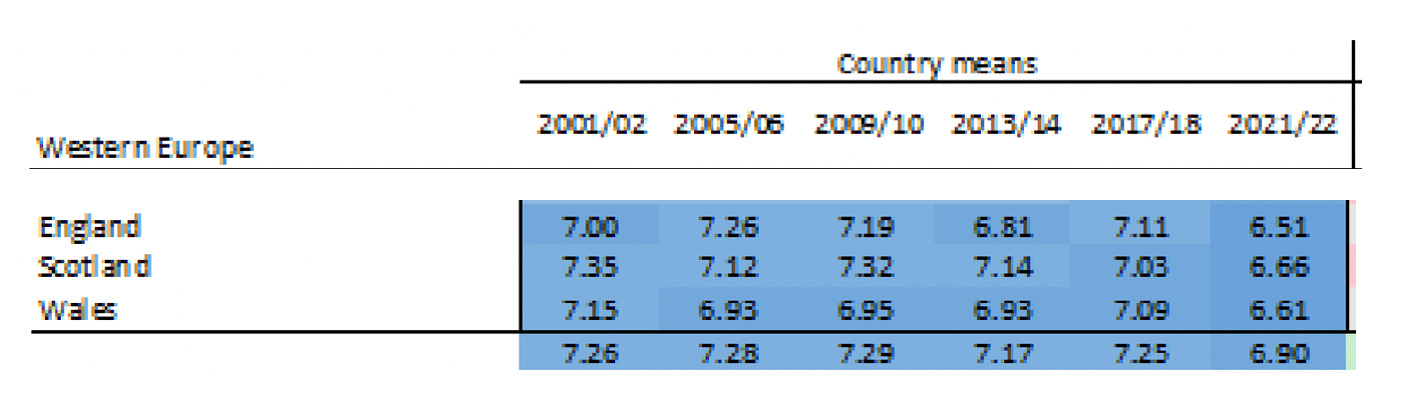
You can see that at the start of this period, all three countries had very similar scores, with Scotland slightly ahead. By the end, all three countries also had very similar scores, with Scotland slightly ahead by an even smaller amount, and all three below the Western Europe average. The major standout trend over this time is not anything to do with the relative position of each country, but the big fall in each country’s scores from 2018 to 2022. This fall was seen across Western Europe and in most of the other regions too - it’s a global fall, and one that it seems plausible to attribute to the Covid-19 pandemic.
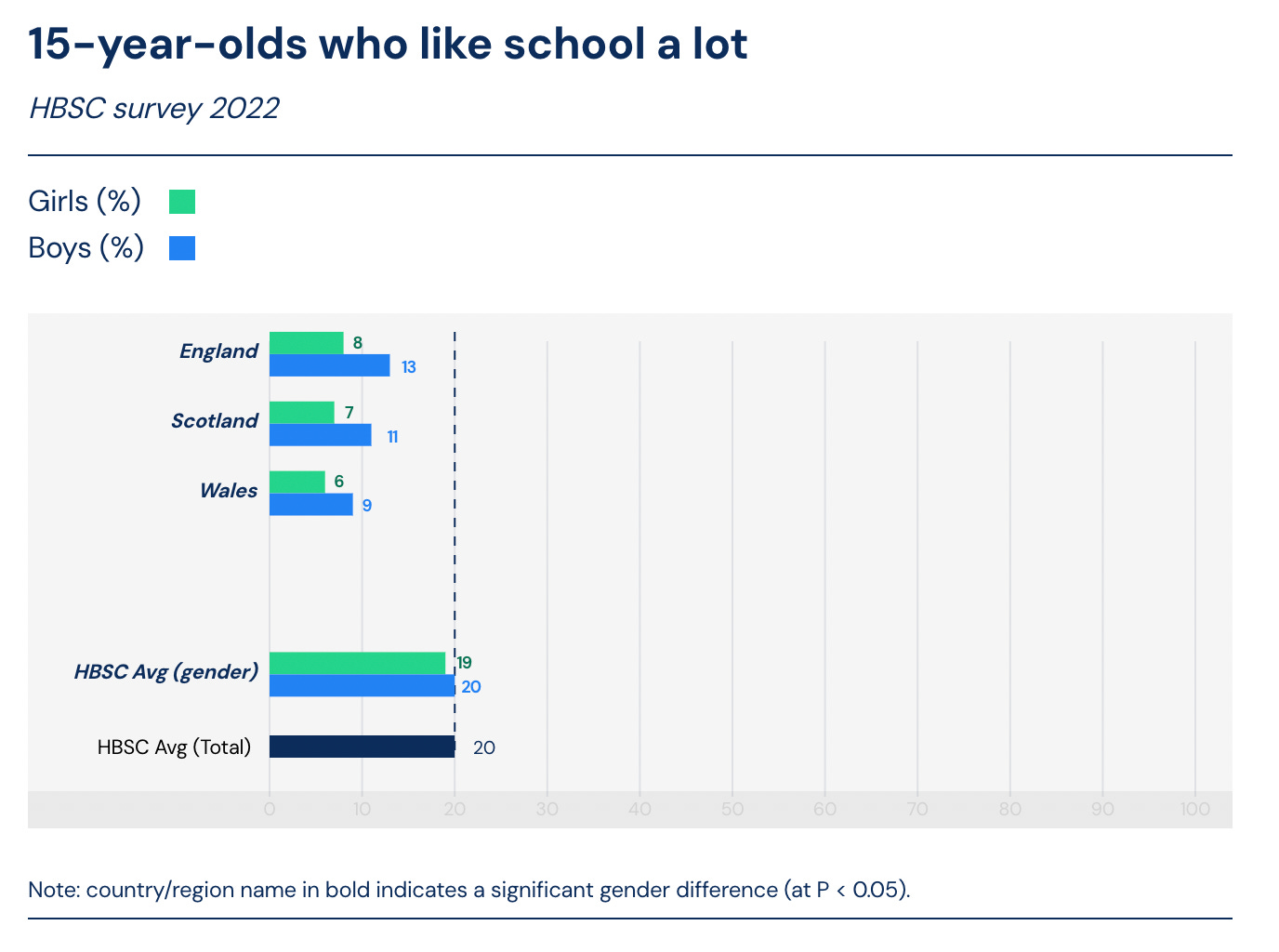
HBSC asks other questions we might be interested in. For example, 15-year-olds were asked how much they like school. The vast majority of English teens do not like school a lot. But the vast majority of Welsh and Scottish teens don’t either.
Most strikingly, there is barely anything to pick between the three countries when it comes to feeling pressured by schoolwork. I found this remarkable - England really does have a lot more exams and less coursework than Scotland & Wales, and I would have predicted this would have led to English teens feeling much greater pressure. But it hasn’t.
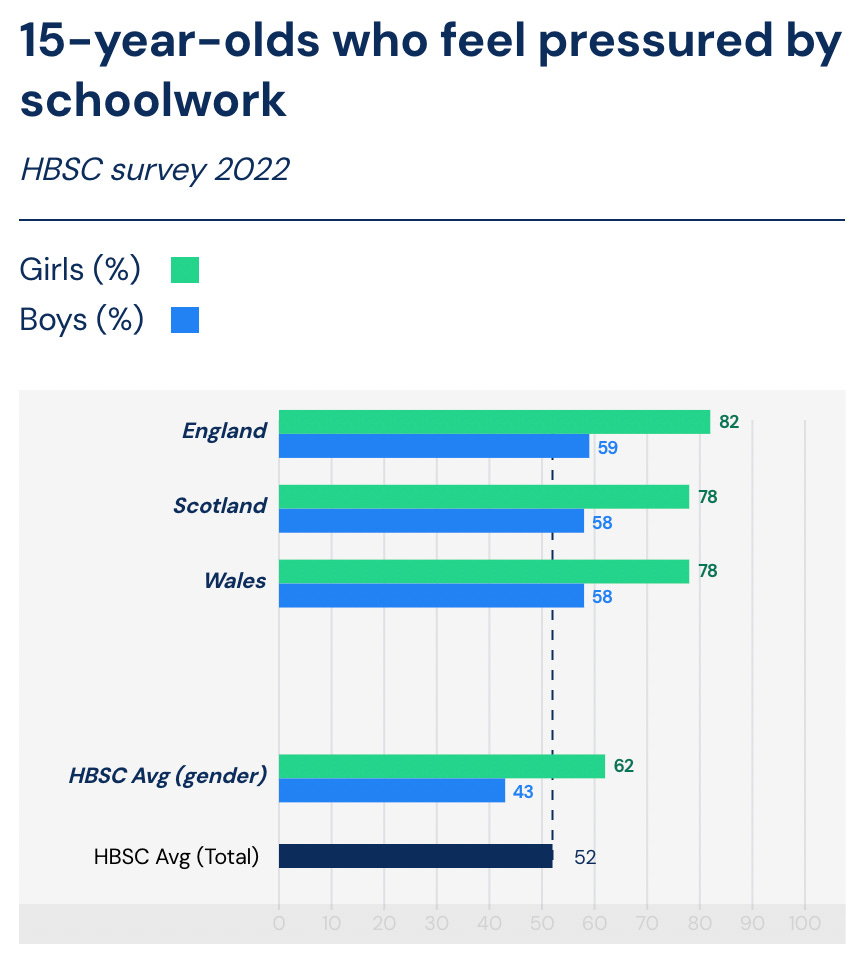
The striking feature of all of this data is the similarity of the three countries’ data, not the differences. Their education policies and attainment scores have definitely diverged. But happiness and wellbeing have not. It is very hard to look at this data and argue that England’s knowledge-based curriculum has made students unhappy, or that Scotland’s skills-based curriculum has made students love school.
What about other studies? The most recent “World Happiness Report” found that the trend of declining teen happiness was particularly stark in Anglophone countries. Under-25s in America, Australia, the UK, Canada, Ireland and New Zealand all had dramatic declines in life satisfaction, more so than in other countries.
What is going on here? People have put forward plenty of possible culprits: smartphones, economic insecurity, the Covid pandemic, housing, family disintegration, and so on and so forth. All of these seem like plausible possible candidates which are at least worthy of discussion.
What is not plausible is to pin these dramatic UK, Anglosphere and global trends on a specific set of education policy decisions that only affected England. Teen life satisfaction is declining in London, Edinburgh, Cardiff, Belfast, Dublin, Melbourne, Auckland, New York and Toronto. You can’t blame this on Michael Gove removing Of Mice and Men from the GCSE syllabus.
What do they know of England who only England know?
When devolution happened in the late 1990s, one of the more wonkish claims for it was that it would provide useful policy laboratories, where one nation could try something different and the rest could learn from a culturally similar region. For example, Scotland introduced a smoking ban in 2006, it went well, and England followed suit in 2007.
For this to work journalists and policy makers in Westminster would actually have to pay attention to what is happening in Scotland, Wales and Northern Ireland - which by and large, they don’t. Time and again I read articles in prestigious publications that lazily conflate England and the UK, implicitly assume that the Westminster Secretary of State has the power to reform education across the UK, and totally ignore the very significant Welsh and Scottish education reforms.1 Just this week, a “Big Read” in the Financial Times made all these errors.
Journalists generally prefer to visit Helsinki and Tallinn than Cardiff; they prefer to talk about how there are no league tables in Finland rather than about how Wales abolished them in 2001 and it had an immediate and negative impact on school performance. More positively, Wales has had notable successes with its SEND policies, but in the acres of newsprint devoted to English SEND reforms you rarely hear this mentioned. Scotland has no university tuition fees for Scottish students at Scottish universities, but there is very little analysis on what difference this has made to subject uptake compared with England.
In Wales, the journalist Rhys Williams has done incredible work on how reading is taught in Welsh schools. In Scotland, Lindsay Paterson’s research on the curriculum demonstrates the power of content knowledge. As mentioned earlier, Northern Ireland are carrying out some far-reaching reforms to their curriculum and assessment system.
At No More Marking, we work with schools across the UK and in the USA, Australia, and New Zealand. Half the subscribers to this Substack are based outside the UK. I’m always fascinated by how the surface features of each system are very different and take time to understand, but often the deeper forces at play are very similar. Sometimes the problems we think are unique to our own system are not, and studying how other systems work can stop us leaping to parochial conclusions about our own.
In some ways it is not unreasonable to conflate UK and England statistics: England makes up 85% of the population of the UK, so if you see a UK population average it is fair to assume that the England average will be fairly similar. That is obviously not true of the other three countries. And in some ways the Westminster government does have power over all UK schools: a recent high-profile policy involved the UK government removing VAT exemption for independent schools. Tax policy is not devolved, so this policy does affect independent schools in Wales, Scotland and Northern Ireland.
Of stark contrast is the significant pressure felt by girls over boys in all countries. Studies to compare single sex schools with co-ed may give greater depth. Am not advocating for either model however we should be questioning why girls are so unhappy.
Smartphone, screentime and social media- read Jonathan Haidt's book The Anxious Generation: The Anxious Generation | Jonathan Haidt https://share.google/748LwO5kqzffFNLCv