

Over the last few weeks, there have been two big education news stories in England: the OECD’s PISA results, and the government’s announcement of qualification reform. Half the subscribers to this Substack are from outside England, and I thought everyone might be interested in an update on what is going on here and how we are perceived in the rest of the world. This post will focus on the PISA results, and a future one will look at new government policy.
England bucks the trend
The first big news story is PISA. On September 8, the OECD released the results of their 2025 PISA tests of 15-year-olds in reading, maths and science. The big global headline was that the OECD average scores on maths and reading were the lowest ever recorded in the history of the tests. And a very significant sub-plot is that England is one of the very few countries to have resisted this downward trend. England’s scores are about the same as they were in 2012, but in the context of massive global falls, that’s a relative success story. England is now one of just two countries outside East Asia to be in the top 10 for all three of reading, maths and science.
The other interesting aspect of the results is the natural experiment going on within the UK. Outside the UK, a lot of people aren’t quite aware that England, Scotland, Wales and Northern Ireland have different education systems. (In fact, a lot of people in the UK have a shaky understanding of this too!) Since 2010, England, Scotland and Wales have embarked on very different education policies. Put simply, England went for a more traditional set of education policies, involving things like a knowledge-based curriculum, terminal exams, phonics instruction, and teacher-led classrooms. Scotland and Wales went for a more progressive set of policies, consisting of things like project-based learning, competency-led curriculums, and more modular and teacher assessment.
But whilst England’s scores have held steady, Scotland and Wales have declined sharply. 15-year-olds in England used to be behind those in Scotland. They are now about a year ahead in maths and science, and ahead by a smaller amount in reading.
The future isn’t what it used to be
I have been making the case for a knowledge-based curriculum since 2010. You can read lots of articles on this theme on my old blog, here. In fact, I first wrote about comparisons between Wales and England in January 2012!
Back then, mentioning things like knowledge or exams in a positive light was beyond the pale. All the buzz – in the UK and around the world – was about 21st century skills, project-based learning, multiple intelligences and learning styles. I lost count of the number of times I was told that Scotland and Wales were looking to the future, whereas England’s policies were taking it back to a mythic past. The received opinion was that in order to thrive in a modern economy, students didn’t need to be burdened by knowledge.
It is hard to recreate the intellectual atmosphere of that time, but perhaps the most striking aspect was that there was not even a debate. It was just naturally assumed that memorisation and drill were outdated, and that the future belonged to 21st century skills. Those were the underlying assumptions that everything else was built on top of. If you questioned them, then at best, people would look at you pityingly, like you were a peasant who thought the earth was flat. At worst they would accuse you of being a crypto-fascist.
For some good examples of this, you can read news articles from the time. The Economist and Financial Times are barometers of elite highbrow opinion in the UK, and they would frequently write articles based on these assumptions. For example, here is a leader from 2014 in the Economist saying that schools need “less rote-learning and more critical thinking.” The Financial Times were happy to publish an article in 2013 calling England’s reforms a “suicide note”. And here’s a particularly bizarre one from the Economist in 2006, which suggests maths practice is only needed if you are going to work on a factory line, and also suggests it is a good idea for students to get bad grades on exams, if the exams aren’t testing useful creative skills.1
However, even before this set of PISA results, evidence has been piling up that competency-based curriculums are not all they are cracked up to be – and as a result, the intellectual tide has shifted. Over the last few years, policymakers in Northern Ireland, Flanders, Australia and New Zealand have looked to England for ideas about education reform. You can also see the evidence starting to percolate out of the education world and into more generalist policy circles. In America, Emily Hanford’s Sold a Story podcast has been phenomenally successful and sparked a national conversation about ineffective teaching of reading. Matt Yglesias recently wrote about similar problems with maths teaching. Tyler Cowen’s blog has featured articles about the value of direct instruction.
In the Financial Times, Stephen Bush and John Burn-Murdoch have both written some excellent articles about the success of England’s reforms. Rather more grudgingly, the Economist acknowledged recently that England’s reforms deserved more attention.2
The PISA results have turbocharged these trends. In his summary of the PISA results, Sam Freedman (who played a major part in England’s reforms when he was a policy adviser in the DfE) mentions that journalists from France, Germany, the Netherlands, and Japan have been in touch with him to try and learn more. I’ve had contact with journalists or officials from Wales, Scotland, Spain, and America. Others in the sector report something similar. In many countries, there is a genuine concern about falling scores - and a desire to learn more about what England are doing. Here is a little selection of commentary from social media.
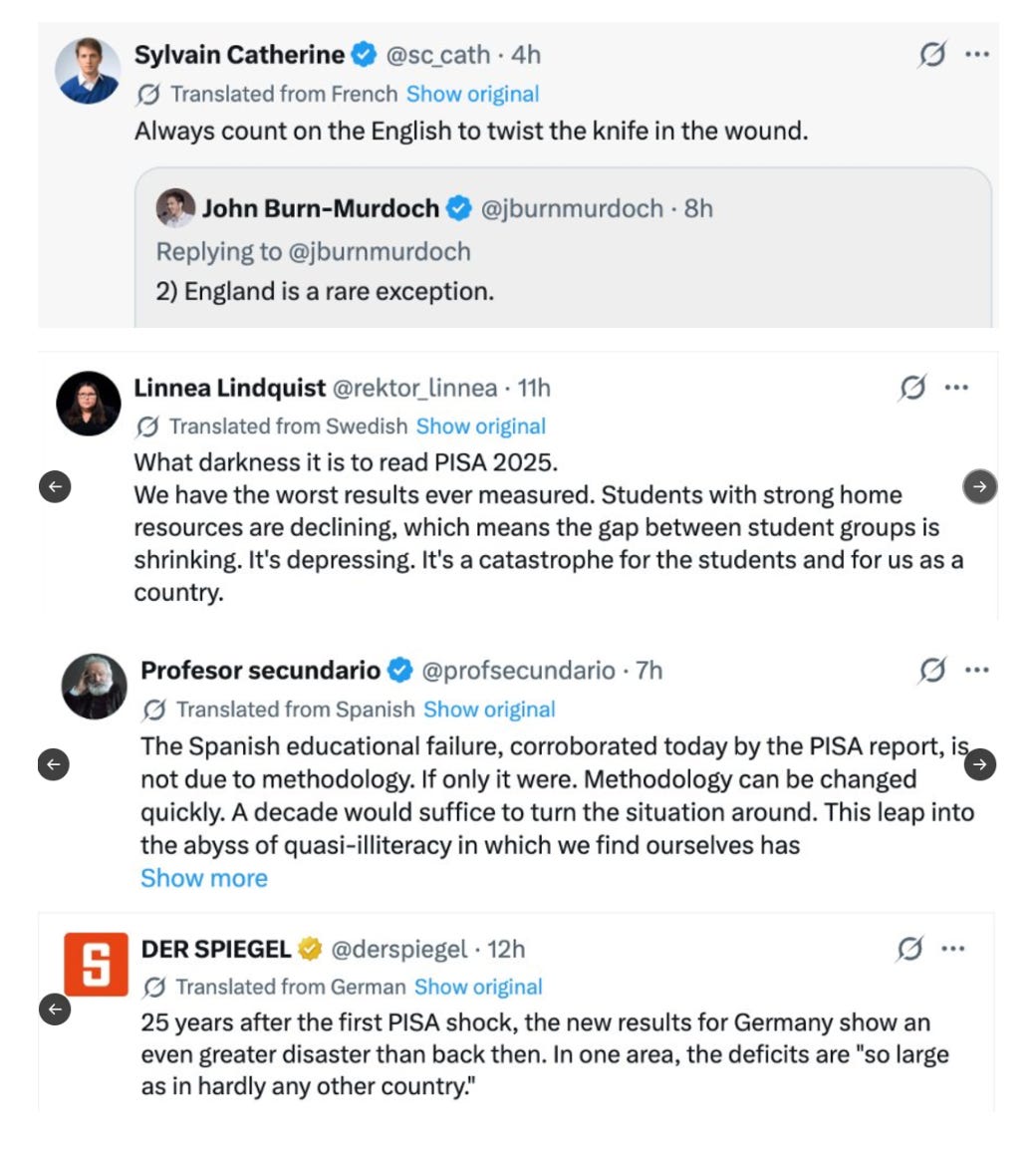
But what if PISA is wrong?
In the days after the PISA results came out, there were some queries about whether we could trust the results. That’s a fair question. If you are being asked to change the way you think about something based on statistics, you should query those statistics! And there are legitimate reasons to be wary of large datasets. In the UK, the Office for National Statistics has gone through a torrid few years, with multiple methodological errors on nationally important data.
And there are legitimate critiques to make of PISA’s approach – critiques that I have made in the past, and am happy to repeat now. The irony of the “can we trust PISA” debate is that PISA is generally regarded as being a progressive alternative to more traditional national exams. It focusses on problem-solving skills and selects content with relevance to real-life situations, meaning that its questions don’t test concepts like photosynthesis and algebra in the same way you would get at GCSE. Its Director, Andreas Schleicher, repeatedly takes the progressive side in education debates, including in a set-piece debate with me in 2017. In 2015, most countries switched from taking the test on paper to taking it on screen. Every now and again, PISA comes up with some kind of new and groovy assessment format that they hope will reward new and groovy skills – and every time, it turns out that the countries who do best at it tend to be the ones doing best on the maths tests.
In short, PISA is a screen-based test of problem-solving skills that requires limited specific curriculum knowledge. If you wanted to design a test that would be least likely to reward England’s educational approach, and most likely to reward the approach in Scotland & Wales, it would be PISA.
And yet, England are still doing better on it.
The main alternative to PISA is a set of tests run by an international research association based in Amsterdam. They run tests of Year 5 and Year 9 science and maths, called TIMSS, and tests of Year 5 reading, called PIRLS. These tests do have more specific curriculum content in them. In the most recent round of each, England was also the only country outside of East Asia to come in the top 10 in all of TIMSS and PIRLS. It was also, again, one of the few countries to buck the trend of falling scores. So on both sets of international tests, which are run by totally different international organisations and which are trying to do different things, England is performing well, and resisting the trend of international declines.
OK, so it works in practice. But does it work in theory?
Back in 2013, I wrote an article talking about the different types of evidence we can collect to see if a particular approach works or not. One important source of evidence involves statistics on student achievement and test scores – evidence like the data from PISA and TIMSS.
But another important source involves scientific theories about how the human mind works. In a brilliant article from 2002, E.D. Hirsch explains the difference between these two sources, with comparison to medical science. He points out that in order to find out the cause of malaria, say, you can’t just rely on statistics that show where you are likely to get sick. You need to put the disease under the microscope and work out what causes it.
Likewise, in education, statistics on test scores are only one part of the puzzle. Hirsch saw cognitive science as being analogous to biochemistry in terms of how it could be used to improve education. He identified some key insights that would be valuable for all teachers to know – and which have become better known over the past decade. Concepts like the relationship between working memory and long-term memory, the nature of forgetting, and the importance of prior knowledge can all help to explain why some teaching methods are more effective than others.
We are now in the situation where the statistics and the underlying science are pointing in the same direction. England adopted an approach to education explicitly influenced by Hirsch and insights from cognitive science. It is now outperforming many countries on international educational surveys.
What should England do next?
As Hirsch goes on to say in his article:
Medical science continues to advance as it becomes allied with ever more refined laboratory understandings. Its most striking and reliable advances have occurred since medicine became closely tied to biochemistry at a still more fine-grained level — the molecular. By analogy, it is plausible to think that progress in educational research, if it occurs at all, will follow this sort of pattern.
In medicine, as in other fields, the practical application of scientific insights has led to dramatic improvements in the quality of life which previous generations would have thought were impossible.
In 1900, one in six babies died before their first birthday. Just fifty years later, that was down to one in thirty. Fifty years after that, in the year 2000, it was down to one in 180.
The development of medicine has involved both scientific and institutional progress. Researchers have advanced the frontiers of human knowledge, and institutions have spread that knowledge and turned it into workable and practical applications.
When I read Hirsch’s article for the first time back in 2013, I was hugely excited. I thought then that there would be enormous and unprecedented improvements available for the educational systems that embraced this kind of approach - particularly given how little-known ideas about cognitive science were!
I still think this. In an article from last month, I suggested that England’s “forgotten third” of low-performing students were not an immutable fact of life. If we spread the best ideas about education to all schools, it should be possible to reduce that number. I suggested that we could legitimately aim for 90% of students reaching the standard that currently only two thirds do. I got some pushback for this figure. Even people who normally agree with me thought that it was too idealistic. But I stand by it. A lot of features of everyday life that we take for granted today would have been seen as wildly idealistic even just fifty or so years ago.
And to improve education, we could gain a lot just by doing better at spreading existing best practice. That is to say, even without any big new scientific breakthroughs, we could still improve just by making effective teaching methods more widely used. So whilst it is an idealistic aim, it wouldn’t necessarily require crazy levels of spending or dramatic innovations. And even if it turns out I am wrong about the 90%, and only 75% or 80% is possible – you still won’t have lost much trying, and most people would still be better off as a result.
In an article last month for Arguably, I outlined one relatively straightforward and cheap policy that could help. You could identify a cadre of 100 or so middle and senior leaders who are working in some of the most successful state schools, and create a bespoke training programme designed to help them become heads at 100 struggling schools.
You could also do more work systematising the features of the best state schools: what do they all do, what do they all say is vital, and what are the quickest and easiest features that could be adopted by all schools.
If you wanted to do something more ambitious, you could attempt to reform university education departments, maybe by linking them with successful schools and Trusts and setting up research programmes based on the requirements of the schools.
And, of course, we have to mention AI here. Even if, like me, you’re wary about screens in the classroom, AI clearly has the potential to help scale up excellent teaching.
At this point, I should acknowledge that none of the above is likely to happen right now in England. This brings me to the second big news story: in the same month that the rest of the world has decided it wants to know more about the education policies that made England successful, the UK’s new government have decided they want to move away from those policies.
The foreign journalists I’ve spoken to are really baffled by this. I keep getting asked some variant of the following. The whole world is worrying about their kids getting dumber. England appear to have the policy solution. And yet the government in England seem to want to reverse those policies. Why is this happening?! To be totally honest, I don’t really know why! But I will have a go at answering it in a future post.
The term “Gell-Mann amnesia” refers to the experience of reading something in a newspaper that you know is wrong, because it’s about a topic you know a lot about. You then turn to the next page and trust the newspaper on a topic you know nothing about. More recently, I’ve read some good Substacks on the concept of “highbrow misinformation” or “elite misinformation”, about the way prestige publications can still misrepresent reality.
It did then blot its copybook the next week by drawing an equivalence between strict teachers and school bullies.
I love this content so much, and I am baffled. I never thought of myself as someone who reflects on education. I agree with almost 100% of what this blog covers. It is almost a form of escapism. I am grateful to the author/journalist thanks to whom I landed on this blog.
Hopefully, the government will reconsider. The English citizens and residents must fight peacefully and democratically to protect this achievement. Nations with Global ambitions cannot afford not to be highly placed in international rankings.
More importantly, receiving a good education improves one's wellbeing. After a certain age, one can feel the quality of tuition they receive, identify teachers driven by the delivery of excellence, and feel good about their future.
So, thank you because your content is very meaningful for social well being. On hundred 💯 agree on your recent article about making sure that even those who will eventually opt for apprenticeships or shorter formal academic life will be given solid foundations in the core subjects.
The analogy with medicine is doubtful. The increase in lifespan, due mostly to reduction in childhood mortality, is not due to medicine. It's due to improvements in sanitation, housing (e.g. more air and light), working conditions, and diet -- in short, class war from below. Medicine likes to steal this credit, but even medical historians recognize that the credit is mostly misappropriated.