

Over the last few months I’ve heard a lot of people arguing that one of the great uses of large language models will be to personalise learning.
I am pretty dubious about personalised education. I wrote a long chapter about it in my 2020 book Teachers vs Tech, where I argued that most forms of personalisation don’t work.
I have also found that many advocates of personalisation rely on a sleight-of-hand. They will start out by asking if, when you were a student, you felt that the pace of a class was too fast or slow. Almost everyone who has ever been a student will have at least one memory of this happening, so that will predispose you to think well of the basic concept of personalisation.
But then when you look at what many actual examples of personalised classrooms involve, you’ll see kids sitting at screens on their own, constructing their own playlists on YouTube and choosing their own form of assessment.
This is a complete bait-and-switch! If the problem is “my maths teacher went too fast and I wish they could repeat that middle step again” the solution is not “demonstrate how to solve equations with iMovie videos in the style of a cooking show. Use props to represent variables and numbers. Combine with other videos to create an equations cookbook.”1
Ultimately, I am dubious about personalising based a) on student interest and b) on student choice. I think there is a lot of basic content that should be compulsory for all students, and not subject to student choice. I also don’t think that students should make their own decisions about how fast or slow to proceed through a body of content, or what kind of activities they should use to study the content, because most of the research shows that they make quite poor decisions.
One form of personalisation I think can work is where students progress through a set body of content at different speeds, based not on their decisions but on their performance. This is how a lot of traditional Intelligent Tutoring Systems work: you have some kind of bank of content, students all start in the same place and then they get given different content and questions based on how much of the previous content they have got right.
I don’t think LLMs change this basic dynamic in any way. The best use of an LLM tutor I have seen is one that essentially followed the above process: the students learnt some maths, the LLM followed up with questions, and it gave more and different questions and explanations to students who got them wrong. The students did not get to choose the content they were studying, and they did not get to choose the pace or the type of activity.
Still, there are a lot of people making a much more radical argument about LLM personalisation. Maybe the most seductive one which seems to be getting the most traction is that we can use LLMs to create personalised textbooks and learning resources that teach new concepts using the student’s own particular interests.
Here is one example.
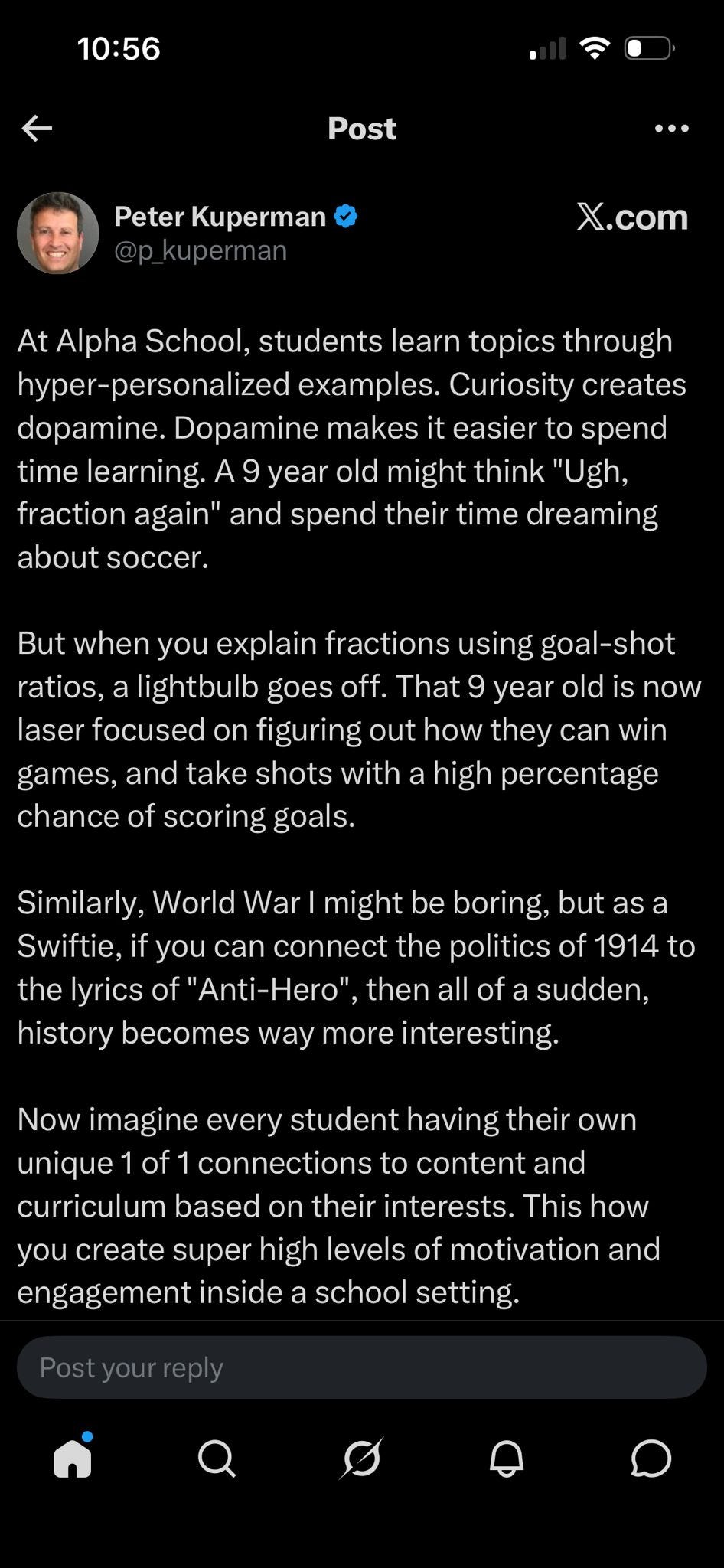
I think this is a classic case of perhaps the classic technological flaw: it is a solution in search of a problem. It is genuinely amazing that LLMs can create a unique and personalised textbook tailored to every student’s pre-existing interests. But I don’t think it is going to help them learn any better, and in fact in some cases it may mean they learn less.
We learn new things by connecting them to old things
The best evidence-based justification of creating personalised resources that are linked to students’ interests is as follows.
We learn new things by connecting them to old things.
Every student knows different old things.
So, it could make sense to have personalised resources tailored to the unique prior knowledge of each individual student.
There is some truth to this. I loved using analogies as a teacher, I love using them on this Substack, and I love hearing them.
Here’s an example. I used to have a lot of problems explaining to students that a particular word could be a verb in one sentence but a noun in another. EG I run to the shops – run is a verb. I go for a run – run is a noun. Most of the students I taught found this incredibly difficult to get their heads around. If run was a verb in one sentence, then they thought it needed to be a verb in every sentence until the end of time.
In one lesson, I spontaneously hit upon an analogy which did help some students. I said something like “imagine my dad. When he goes to work on Mondays and Tuesdays, he is an electrician. But he also works as a plumber! When he goes to work on Wednesdays and Thursdays, he is a plumber! He fixes the drains! That’s like the word “run”. Sometimes it works as a verb! Sometimes as a noun.”
This analogy definitely worked for some students, and you could see the fabled “lightbulb moment” they tell you about in teacher training. So when an analogy does work, it is brilliant.
But what happens when you don’t know many old things?
But for some students, it didn’t work. They looked just as confused, and one student once said “what’s a plumber”. And that’s lesson one of creating a good analogy. If you have to explain the thing you’re comparing it to, it’s failed. It’s serving not as an explanation, but a distraction. Another important principle of cognitive science is that “we remember what we think about”. If one of my students ended up thinking more about plumbing than about verbs, then the lesson didn’t work for them.
So the first principle of creating a good analogy is that your comparison has to involve something students understand very well, something that doesn’t need explaining.
Aha, you might say, but isn’t this where the AI can help? Those students who didn’t know what a plumber was might know who Taylor Swift or Lionel Messi are, and you can reframe the analogy using them instead. You can say “Lionel Messi plays for Inter Miami most of the time, but in the summer he plays for Argentina!”
That’s true, and it’s possible this analogy might work. (It’s also possible it could be distracting in another way – by reminding students that something exists that is far more interesting than verbs and sentences.)
However, even if this analogy did work, the reality is that most students have pretty limited prior knowledge, and this severely limits potential options for creating analogies, because not everything can be explained through the medium of Messi or Taylor Swift. I find there are a lot of useful life analogies to be drawn from the history of football, but even students who like football a lot still don’t know enough to access these.
When students express an interest in football, they tend not to mean “I want to hear your hand-crafted analogy about how the Old Firm’s religious selection policies can be used as the basis for a game theoretic model showing why universalist institutions often outcompete exclusionary ones”. They tend to mean “please can we watch a Messi / Ronaldo goals compilation on YouTube if we finish our work early”.
Which brings us to the second principle of creating a good analogy.
We learn new things by connecting them to old things. But we don’t learn new things by connecting them to any old thing.
Analogies and links to prior knowledge have to be chosen not on the basis of the students’ interests, but on the basis of what works for the content you are teaching. This is going to involve judgement calls and case by case decision-making, but we can see some obvious examples that do and don’t work.
Electricity is often described using a water and pipe analogy. Maybe that is not the most fascinating analogy, and it is not something students are that interested in. But most students probably do know what water and pipes are, and I don’t see how you are going to improve on it using basketball or Taylor Swift or the World Cup.
I am making a very similar point here to the one made by critics of learning styles. The reason why learning styles don’t work is because you have to pick the style based on the content, not the learner’s preference! EG, if you want to learn where the countries are on a map of Africa, that is just inherently a visual task. It doesn’t matter if you prefer listening to podcasts to looking at pictures. You’re going to need to look at pictures to master that particular content.
Even well-chosen analogies and connections are just a first step
There is a big argument within the philosophy of science about metaphors and analogies and whether they end up restricting our understanding of reality by forcing it into certain pre-conceived formats. They probably do. It may be the case that describing electricity as water in a pipe stores up some longer term misconceptions.
But it is probably also the case that electricity is such a difficult and abstract concept that it requires some kind of concrete analogy as a starting point, and whichever analogy you choose will be wrong in some way. But some will be less wrong than others. There’s a famous saying that “all models are wrong, but some are useful.” I would update it with: and some are useless!
So how do we work out which connections and analogies are useful and which are useless?
I would recommend three approaches.
First, for maths and science in particular there is an extensive literature on this. So you could start there.
Second, for subjects or analogies where there is no research, you could run your own research. One of the reasons I love assessment so much is that it does provide a way of validating intuitions like this. Not everything has to be a gold standard RCT to be useful. One of the advantages of AI is that there are lots of ways in which it could make micro-validations more feasible. Our AI writing assessments let you quickly measure the impact of an intervention.
Third, you are always allowed to use your common sense. One of my friends who is still in the classroom says that the problem with education becoming too research-informed is that it’s stopped people making common sense in the moment decisions. Parachutes have never been subject to a randomised controlled trial, but you are allowed to say “I’m not jumping out of a aeroplane without a parachute”. You’re also allowed to say “I don’t think Taylor Swift’s Anti-Hero is a great analogy for teaching the causes of WWI.”
Of course, if you do think it’s a great analogy, feel free to validate it using one of our Comparative Judgement assessments! Our next training webinar is on July 1.
A real example https://education.apple.com/learning-center/T044895A-en_US
I just wrote a whole IB TOK lesson around technology and personalisation. A long time ago I was heavily influenced by Neil Selwyn's, Is Technology Good for Education? and it comes through clearly in the lesson: https://www.internationalschoolhistory.com/perpectives-in-technology.html But the bottom line for me has always been that the point of schools is to teach kids what they couldn't learn elsewhere and wouldn't want to learn unless we forced them to. We do education because it is good for them and in the long-term interests of society.
In spirit of analogies...I liken personalized learning in K12 to learning how to cook. You can put a novice chef in a kitchen full of the most wonderful gadgets and ingredients...but without any input from the master chef, will you get a good meal? I am responsible for teaching my students foundational work such as "knife skills", "seasoning", "Mother sauces", "doneness", and basic cooking methods: frying, roasting, etc. Once these are mastered, the student is then knowledgeable enough to go forth and learn any new recipe they are interested in learning, and I can help them with the tricky parts - but until someone shows them around the kitchen...
Yes, doing hand calculations can be a bit boring and uninspiring just like cutting an entire bag of onions to drill the importance of cutting consistency can be as well...but what you do with this skill is really where the personal part comes in.