

What is Alpha?
Alpha School is a network of American private schools with a different model of education. Their students learn academic content through apps for two hours of the day, and then have the rest of their time free to focus on projects and life skills.
They’ve got a lot of attention in the UK recently because they’ve employed a number of people with experience in the English education system.
I haven’t visited any Alpha schools, but I’ve had a few conversations with people who have, and with some of the people now working for them.
A lot of people have asked me my opinion about what they are doing - so here it is, for what it is worth.
What I like about Alpha
In 2020, I wrote a book called Teachers vs Tech about some of the historic problems of ed tech. One of them is that big Silicon Valley tech firms are capable of coming up with terrible ideas about education that are totally unmoored from anything to do with the science of learning.
Maybe my favourite example from my book is an Apple Educator guide which recommended the following activity for teaching maths: demonstrate how to solve equations with iMovie videos in the style of a cooking show. Use props to represent variables and numbers. Combine with other videos to create an equations cookbook. “Equations Cookbook” is now my shorthand for ed tech eccentricity.
One of the things which first impressed me about Alpha was that they did not seem to be going down this route. Instead, they seemed to be taking the science of learning seriously. One of the first things I read about them, back in the summer of 2025, was that their schools were using an online maths app called Math Academy.
Math Academy is explicitly based on science of learning principles, and its founding document, the Math Academy Way, is very good. Now, there are legitimate questions about whether Math Academy is sufficiently motivational for most students, whether it will work for younger students, or whether it works in the absence of a human teacher – but it is absolutely light years away from Equations Cookbooks. So for me, that was a definite positive.
Another positive is that they have employed a lot of very talented educators who have been involved in England’s science of learning movement. This is another tick in the box: it obviously shows they can recognise talent when they see it. They are paying very generous salaries too – but that is a positive for me! I would like there to be more money for good people and ideas in education!
Historically, so much public and private money in education has been wasted on ideas with very little evidence behind them. For a long time I’ve thought it would be brilliant if either a company or a country put a lot of financial and intellectual resources into building an education programme based on the science of learning – and if that programme could include some sensible uses of technology. Because bad ideas have been dominant for such a long time, there is so much low-hanging fruit for organisations who come along with good ideas.
The big question is: to what extent is Alpha really guided by a coherent set of good ideas?
What I don’t like about Alpha
In the last year or so, there have been a couple of times when I have had in-depth conversations with Alpha employees about what they are doing and have come away really impressed by what they’ve said.
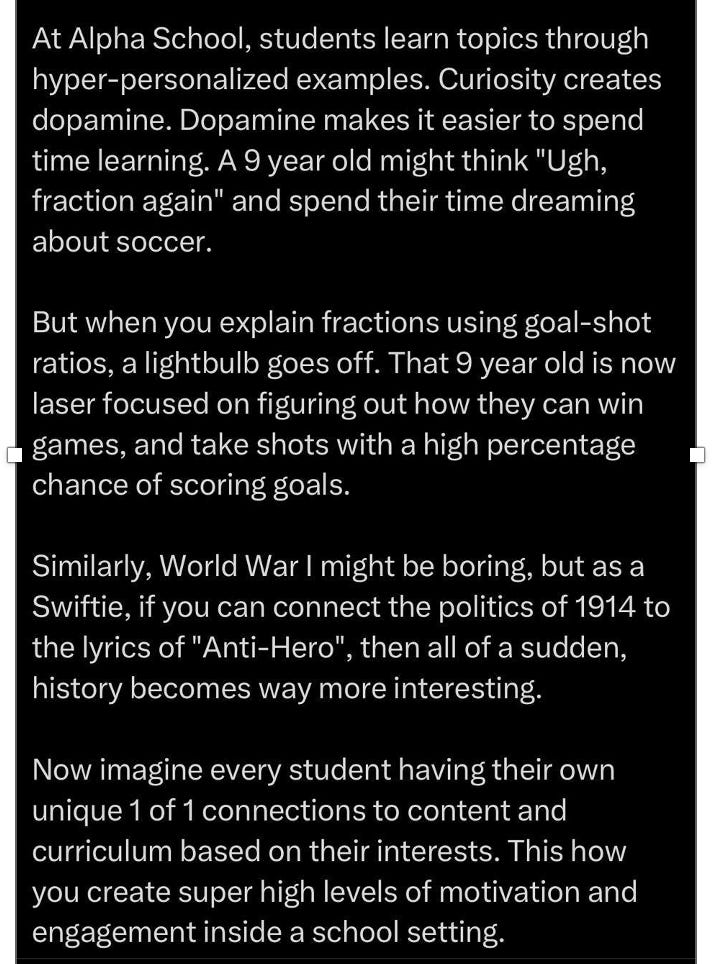
I have then logged on to social media and found other Alpha employees posting things like this. (See here for my analysis of this.)
Then there is the programme for the Alpha School boot camp, which features activities like this.
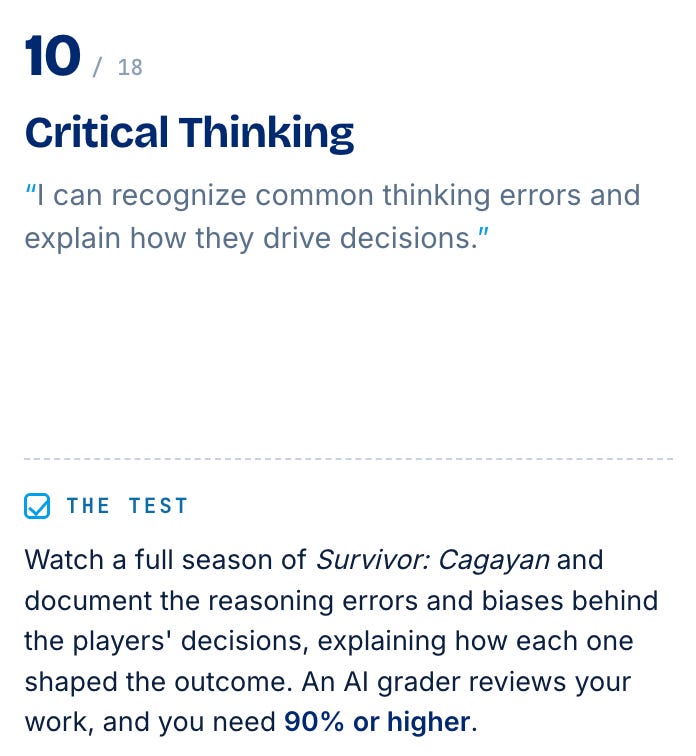
This is all just boilerplate Equations Cookbook.
So what is the reality of Alpha? Is it Math Academy? Is it the plans and visions I hear from some of their staff? Or is it teaching the First World War through the medium of Taylor Swift?
I don’t know. I’ve heard some people who are sympathetic to Alpha say that you should just discount what the marketing team say, because it’s just the marketing team. I don’t think this is quite right. If prospective parents and students are joining Alpha with the promise of critical thinking through Survivor box sets, they will understandably expect that.
Reading between the lines, it seems as though there are some very different views within the company, and it’s not clear which view is going to come out on top. Of course, a lot of start-ups are like this, and some manage to resolve the tensions and find a workable and coherent model. Still, it feels like a significant enough issue to give you pause.
For me, the other stumbling block is the relatively heavy reliance on screens for academic content. Again, a major pillar of the model is that you learn academic content through apps for two hours a day, with the rest of the day free for projects. My take on this is that there are limits to how much children can learn through screens.
I think there are age and content differences: I think screens lend themselves well to rapid retrieval practice, but less well to deep reading. I think that 25-year-olds can learn from screens in ways that eight-year-olds can’t. I think even the best educational apps need some kind of support from trained teachers. Alpha’s classrooms are all staffed with humans (very well-paid humans) but they are not required to know the content the students are learning – they are there to motivate and encourage the students. I am not sure that you can separate content and metacognition like this.
There is long-standing research on the “video deficit” which shows that very young children do not pay attention to adults on a screen in the same way they do with adults in real life. (If they did, it would be really easy for all kids to become bilingual!) There is also lots of research on the evolutionary origins of cognition showing the importance of things like shared gaze, gesture, shared attention, and so forth. I don’t think it is that easy to unbundle the content of learning from its physical manifestation in human experts, particularly when it comes to teaching young children and novices.
Do we need different models of education?
One defence of Alpha is that we do need some different models of education, particularly given the impact AI is going to have. Again, this is something I am relatively sympathetic to. After some scepticism, I am fully on the AI hype train. It is a completely transformative technology with big implications for education.
Also, even in the pre-AI world, I was always supportive of school choice, new school models, and philanthropic involvement in education - far more so than some people who are now working for Alpha. I can remember having a big debate about this at a Teach First event many years ago. One of the people who disagreed with me the most, and who argued that increasing school choice would lead to increased inequalities, was Laura McInerney - who is now working for Alpha. Laura also took on the DfE in a legal battle over free schools.
You can be in favour of school experiments, as I am, without thinking that every single individual experiment is going to succeed. Indeed, I think, to be a really honest pro-experiment person, you have to support experiments that you think won’t succeed, and you have to accept that most experiments fail.
My basic thesis for AI in education is set out here. The analogy I like to use involves the way cars are regulated in Germany: you can be in favour of motorways with no speed limits, and also of medieval town centres where cars are banned. That’s not a contradiction. Similarly, it’s not contradictory to say that AI is going to be a transformative learning technology, but also that if we want to protect deep learning and thinking, we need time and space in the school curriculum where students read actual books and write their thoughts down about them on paper.
So the experiments I am interested in are those which use AI to enhance screen-free learning time.
I’ve written quite a bit about how much better handwriting recognition has become, and how, paradoxically, that advance in technology makes it easier to go back to using paper for assessments.
The other two big AI-driven advances which are really similar to this are speech-to-text technology, and text-to-speech technology. We have a little bit of experience with these at No More Marking, with our audio feedback option that makes it very easy to turn audio comments from teachers into written records. But I think there is a lot more that could be done in this space.
One application I saw recently that I loved is adaptive real-time spoken times table practice. Maybe also the old-fashioned language lab could be transformed by AI recording and analysing student conversations and providing teachers with an actionable summary of real human conversations.
These are all promising AI-enabled experiments that don’t require much screen time.
What about scale?
Another big argument made in favour of Alpha is that we need more technology in education, because it is really hard to scale up good human teaching.
This was a major theme of my 2020 book, and it remains a major theme of this Substack - eg see here. I frequently refer to OECD data showing that variations within schools are greater than variations between them: essentially, what this means is that even high-attaining schools don’t have consistently high-quality teaching in all their classrooms.
Scaling up any system that is heavily dependent on humans is hard, whereas it is often much easier to scale up a system that relies on technology. This dynamic is central to most discussions of technology, and is poorly understood. Let’s suppose that on a given task, a machine is only 80% as good as the best human. Only humans are capable of hitting 100% on this task. A lot of the time, people will look at that and conclude that the technology isn’t good enough. However, let’s also suppose the median human performance on this task is just 50%. In that case, at a system level, the machine is going to win – because the machine will be able to replicate the 80% easily at scale, whereas humans can’t.
If we apply this to teaching, the thesis is that the best human teachers may well be better than an app – but there aren’t very many of them and it’s impossible to create more. The app only has to be better than the median human teacher to be better for most students.
What do I think of this thesis?
Whilst I buy the general principle that scaling up human excellence is harder than scaling up technology, I think that teaching is – at least currently – an exception. There are a lot of pretty decent educational apps out there, but how many of them work at the scale of a national or regional education system? How many of them can actually operate without any skilled human oversight? How many of them could actually be used to teach entire curriculums, as opposed to just being used for certain topics, or for homework? We had a natural experiment during Covid and the answer is: not many. Of course, since Covid we have had huge developments in AI, so it is legitimate to say that this time will be different, and we need to develop new systems. But we still have to accept the reality that currently, it is hard to scale student-facing ed tech.
By contrast, whilst it is certainly hard to scale up excellent human teaching, it is not impossible, and we have good recent examples of this. My favourite example is what has happened in England with early reading instruction. About 15 years ago, England reformed the way early reading was taught with a few important policies: matched funding for phonics resources, better teacher training in phonics, and a phonics assessment at the end of Year 1. These reforms used very little classroom technology.
From 2012 to 2019, the percentage passing that check went from 58% to 82%. By 2026, the percentage passing by the end of year 2 was 89%. This is across a cohort of 600,000 students per year, in 16,000 schools. So those reforms affect 600,000 students every year, and have arguably led to 140,000 - 180,000 students a year learning to decode who wouldn’t have done otherwise.
I just don’t see any very tech-heavy, human-light approach that has achieved anything like that scale for anything in education.
The other remarkable thing about this is that England achieved it without paying its teachers anything like the salary of Alpha’s guides. The guides seem to be earning about twice as much as an English primary teacher.
Is it possible I am wrong?
Yes, of course. One of the reasons I am pro-experiment is because you do need to try new stuff to see if it will work or not. It is hard to predict in advance which new stuff will work and which won’t. We learn through experimenting, seeing what works and what doesn’t work, and iterating.
This is especially true given the transformations AI is bringing about. We set up this Substack to chart our journey through the minefield of AI and AI in education, and if you read it from the start, you’ll know that we’ve changed our minds on quite a few things. I am happy to admit that I got things wrong. This post, for example, from November 2023, is probably the one I got most wrong – although I will also counter with this, from Feb 2023, which I 100% stand by.
What I have always tried to do is to frame my predictions with testable hypotheses. For example, in this article from November 2025, I was pretty sceptical about AI tutors, and I set out four reasons why. Just two months later I revised my opinion after reading a research paper from Google and Eedi which addressed my objections. One of the things I liked most about this paper was the way it had thought hard about how to embed an AI tutor within a traditional teacher-led classroom.
So let’s try something similar for Alpha. What would have to happen for me to think that they are going to transform education for the better? There are obviously lots of things – but here are two suggestions.
I would like Alpha to produce an AI-powered maths tutor for upper secondary that is as effective as the Google & Eedi collaboration, or better.
I’d like to see an Alpha app or group of schools get 90% of 100k + students to pass some kind of phonics screening check at age 7.
These are ambitious goals, but they are realistic in that they are currently being achieved by others.
How will we know if Alpha is working or not?
One of the challenges of working out whether Alpha’s model is working or not is that America and its individual states don’t have the same kind of accountability framework as in England. This is obviously going to sound a bit jingoistic, but England’s Progress 8 metric makes it easier to compare schools with a robust metric that is hard to game and which measures progress, not just attainment.
It’s often said that it’s really bad to sum up a school with one number. I understand that argument, and clearly any one number will miss things. Still, the alternative of not having any number at all that can sum up a school is probably worse.
Alpha’s famous claim, used in many of its marketing materials, is that the students in its schools learn at twice the rate of students in other schools. Their metric for this is MAP standardised test data in maths, reading and language usage.
What exactly does “twice the rate” mean? There seems to be some confusion within Alpha’s own publications about this. For example, this presentation says “At Alpha, we commit to parents that their child will learn twice as much in two hours per day as they would in six hours of traditional school”. That actually seems to imply more than 2x growth. If you can learn twice as much in one third of the time, that is six times as much learning per instructional hour.
Later in the same presentation, the claim is defined differently as: “We use MAP as our third-party grader. MAP measures how much students learn each year. At Alpha, we will double those scores. Let’s take a couple examples. As you can see in this grid, the 50th percentile fifth grader goes up four points in math in a year. At Alpha, that student will go up eight points.”
These two claims have a subtle but important difference that I think matters. The stuff you learn in a lesson - let’s say, four or five new words or prefixes - does not neatly map on to improvement on a summative vocabulary test like MAP. It is possible to learn twice as many words as another student in one lesson, and not end up making twice as much progress on a summative vocabulary test. I explored this difference in a lot more detail in my 2017 book Making Good Progress.
In another article, Alpha’s founder refers to the famous Benjamin Bloom two-sigma paper and says “Two sigma! Twice as effective!” But two sigma does not mean twice as effective. It means two standard deviations away from the mean, which is quite different. I am also quite wary of comparisons to Bloom’s two-sigma paper: as I wrote here, I think it’s a really misleading paper that doesn’t deserve anything like its outsize impact.
MAP is a reliable standardised test of the type I like, and I am glad Alpha are using something like this, not teacher assessment. However, MAP is not a nationally mandated test, and there’s no one centralised authority reporting school-level gains on these tests in a reliable and comparable way. Yes, it is true that Alpha have published some of this data themselves – eg see here – but it has gaps. In that particular set of data, 154 students have matched data for maths, but only 88 for science. We don’t know if every student was included in both the baseline and progress measure.
Likewise, the New York Times published a big article recently saying that they had seen data showing that half of Alpha students don’t make the advertised 2x gains in maths. But again, this was data the NYT had seen – it’s not publicly available, so it’s not possible to analyse it and see what is going on. To the extent that comparable system-level data is available in the US, it’s at the state level. From that data, it appears that students in Alpha’s public school in Arizona are not doing that well compared to Arizona state averages.
So again, if we are looking at things that would make me more positive about Alpha’s potential to achieve change at scale, it would be a clearer and more statistically robust statement of what it thinks it is possible to achieve, what its targets are, and then some clear releases of data with pre-defined metrics and data on matched students and drop-outs. Of course, to be fair to Alpha, there is a limit to what they can do here: they can’t unilaterally create something like Progress 8 and they can’t force other schools to follow their assessment structures. But still, extraordinary claims require extraordinary evidence, so it would be good to see some further clarity on this.
One area where I am sympathetic to Alpha is that I do think impressive and extraordinary gains are possible. In my post on Bloom’s two-sigma paper, I point out that there are a handful of schools in England achieving actual (or close to) two-sigma improvements over a period of five years with cohorts of typical, non-cherry-picked students. For me, these are the kinds of schools we should be looking to emulate and scale.
Graeco-Roman brain drain
Quite a few people – interestingly, lots of them in America – are fed up with the level of attention Alpha is getting. After all, it’s a small group of private schools educating a few thousand wealthy American students. Why are we getting so worked up about it?! Why is everyone writing Substacks about it?
In 1944, as British hard power declined relative to America’s, the future Prime Minister Harold Macmillan told a colleague that Britain would have to play Greece to America’s Rome. Greek slaves played an important intellectual and cultural role within the Roman Empire. Macmillan’s argument was that British elites would in effect become like the Greek slaves who ran the Emperor Claudius’s administration.
Nearly twenty years later, at the time Macmillan was Prime Minister, the phrase “brain drain” was coined by the Royal Society in a paper talking about scientists and engineers leaving the UK for better salaries in the US.
This, for me, is why I am justified in writing about Alpha – and why, even if you are not interested in education, you might be interested in it. Alpha are not the only American employer who can outbid British ones. Whatever you think of the decisions of the individuals involved, it is worth thinking dispassionately about the causes and consequences of those decisions.
What should we do?
Whilst the British economy may be struggling compared with America’s, it is also true that every western democracy spends huge amounts on school education.
In England, we spend almost 70 billion a year on schools alone. For an individual to spend that much every year on schools, they would need an investment fund of two trillion. That is to say, the UK Education Minister is in charge of a budget so big that it would make Elon Musk green with envy.
The amount spent on highly effective programmes like phonics is a rounding error in this budget. It would be possible to run two or three more programmes like this – a “phonics for writing”, a vocabulary acquisition programme, a headship training programme – which would have the potential to be far more transformative than anything Alpha is or could be doing.
In some ways, there is a brain drain, and in some ways, money is a problem.
In other ways, we have a lot of monetary and intellectual resources. We just lack the political will and vision to employ them.
In conclusion…
On the one hand, Alpha do seem to be aware of the science of learning and to be aware of some of the ways in which that science of learning has been developed and implemented in England in the last couple of decades. As I said at the start, it is kind of flattering to see that they want to employ some of the best people in English education. I have heard from non-Alpha linked friends who’ve been in America recently that “learning scientists from England” is becoming a known concept!1
On the other hand, it does feel like there are some important parts of the English lessons of the last decades that Alpha are missing. In particular:
the way that some of the successful large-scale programmes like phonics worked
the importance of having a rigorous assessment metric that is hard to game
the successful schools who are getting two-sigma improvements
I would like these features to be the ones that are developed and scaled up. That doesn’t really seem to be Alpha’s priority, and as I’ve written in other posts, it isn’t the British government’s priority either.
The very frustrating thing for those of us still working in England’s science of learning movement is that there is no desire to scale up some of these successful features. The billionaires in America are not really interested in it, and the billionaire that is the British state is not interested either.
It’s a demoralising time because I suppose a lot of us thought that if we did produce incredible learning gains, then people would be knocking down the door to want to copy them. That has not happened. It might have been less depressing to have been proven wrong than to have been proven right – only for anyone with any power, influence and wealth to ignore what happened and just do whatever they wanted to do anyway.
I remain hopeful that eventually our successes will scale. Maybe it will need people to exhaust a lot of other opportunities beforehand, but ultimately I think reality is an undefeated champion, and the reality is that some stuff works and other stuff does not.
Some of the educators who have gone to work for Alpha are not English, but have worked extensively in the English system.
Really helpful piece. Like you, I think Alpha will probably fail but quite like experiments (especially if they are ones which families with a lot of other options are voluntarily entering into).
Two other thoughts I had:
1. One point people have made is that given Alpha costs c. $50k per child, it's of limited interest as it can't scale. So far in education we've not found great ways of converting more money to better performance (some state schools do as well as some of our top private schools). I don't think they will, but if Alpha did find a way of getting dramatically higher learning for that sum of money, that would have a bunch of societal implications.
2. To me, what Alpha looks like most is a bunch of people who've said traditional learning and knowledge is overrated - maybe because of AI, maybe because of something else - and they actually want to inculcate character/entrepreneurship/risk-taking etc. (hence they spend all the time doing the afternoon things, including the kids on social media stuff) which they value more and see to the key to success. Maybe some think traditional school actually inhibits this type of entrepreneurship. I think they're probably wrong here, and that the current breed of entrepreneurs actually benefited a lot from classic knowledge/learning (even if they think they don't), but it's not a fundamentally insane proposition, and Alpha looks quite like what you'd design if you'd believed that.
2.5 (One other possibility is that Alpha does succeed in turning out more entrepreneur/VC/leader types, but also has a much higher failure rate - maybe some people with $50k a year to spend would see that as acceptable!).